Small Business in India: Opportunities, Challenges and How to Start
Learn how to start and grow a small business in India, including business planning, registrations, digital marketing, finance and growth opportunities.
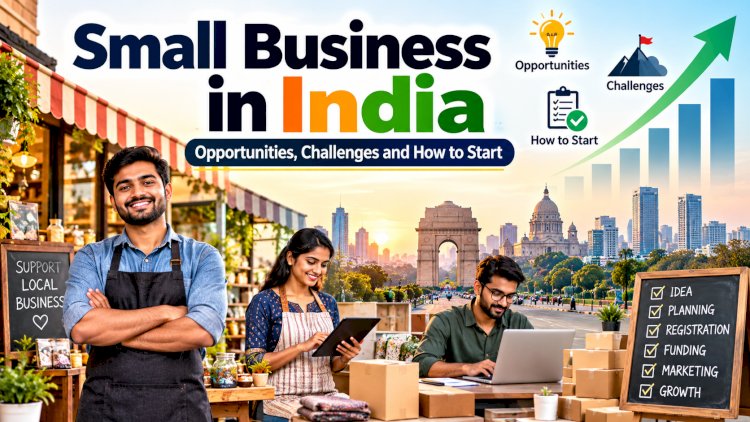
Small businesses are an important part of India's economy. From retail shops and service providers to online businesses, food enterprises, manufacturing units and professional services, small businesses create employment and provide products and services to local communities.
With digital payments, social media, e-commerce and online government services becoming more accessible, starting and managing a small business has become easier in many ways.
What Is a Small Business?
A small business is generally an independently owned and operated enterprise with a relatively limited scale of operations compared with large companies.
Small businesses can operate in many sectors, including:
- Retail and wholesale
- Food and catering
- Manufacturing
- Automobile services
- Construction
- Real estate services
- Digital marketing
- Education and training
- Professional services
- E-commerce
- Transport and logistics
- Repair and maintenance services
How to Start a Small Business
Starting a business requires more than simply choosing a product or service. Entrepreneurs should first understand the market, customers and financial requirements.
1. Choose a Business Idea
Identify a product or service that solves a customer problem or meets an existing demand.
2. Study the Market
Before investing money, research competitors, pricing, customer demand and the location or online market you want to serve.
3. Prepare a Business Plan
A simple business plan can include:
- Business idea
- Target customers
- Products or services
- Pricing
- Expected investment
- Monthly expenses
- Marketing strategy
- Expected revenue
4. Select the Business Structure
Depending on the business, an entrepreneur may consider structures such as:
- Proprietorship
- Partnership
- LLP
- Private Limited Company
- One Person Company
The appropriate structure depends on factors such as ownership, liability, taxation and future growth plans.
5. Complete Required Registrations
Depending on the nature of the business, registrations or licences may be required.
These can include GST registration, Udyam/MSME registration, Shop and Establishment registration, FSSAI registration, professional tax, trade licences or other sector-specific registrations.
Requirements vary according to the business and location.
Digital Tools Are Changing Small Businesses
Technology is increasingly becoming part of everyday business operations.
Small businesses can use:
- Digital payment systems
- Business websites
- Social media
- Online advertising
- Accounting software
- Customer relationship tools
- E-commerce platforms
- Online government portals
A strong digital presence can help a local business reach customers beyond its immediate neighbourhood.
Marketing for Small Businesses
Marketing does not always require a large budget.
Entrepreneurs can promote their businesses through:
Google Business Profile: Helps customers find local businesses online.
Social Media: Instagram, Facebook and YouTube can showcase products, services and customer experiences.
WhatsApp Business: Useful for customer communication, enquiries, catalogues and follow-ups.
Local Marketing: Pamphlets, referrals, partnerships and community promotions can still be effective for local businesses.
Financial Management Is Important
Many small businesses face difficulties because business owners do not maintain proper financial records.
Entrepreneurs should keep track of:
- Sales
- Purchases
- Expenses
- Cash flow
- Receivables
- Payables
- Taxes
- Inventory
- Business loans
Separating personal and business finances can also make accounting and financial management easier.
Common Challenges
Small businesses can face several challenges, including:
- Limited capital
- Competition
- Finding customers
- Rising operating costs
- Cash-flow problems
- Compliance requirements
- Hiring suitable employees
- Changing customer preferences
- Adapting to technology
Planning and maintaining accurate financial records can help businesses manage these challenges more effectively.
Opportunities for New Entrepreneurs
India's growing digital economy is creating opportunities across several areas.
Entrepreneurs can explore businesses connected with:
- Online services
- Digital marketing
- E-commerce
- Food businesses
- Electric vehicles
- Automobile services
- Home services
- Education
- Healthcare support services
- Logistics
- Professional consultancy
- Local manufacturing
The right opportunity depends on the entrepreneur's skills, available capital, location and understanding of the target market.
Government Support and MSME Registration
Eligible businesses may consider Udyam Registration to obtain official MSME recognition. Depending on eligibility and applicable schemes, registered enterprises may have access to certain government programmes, benefits or support mechanisms.
Entrepreneurs should check the latest official rules and scheme conditions before relying on any particular benefit.
Conclusion
Starting a small business can be an important step towards financial independence and long-term entrepreneurship. Success generally requires a clear business idea, proper planning, customer understanding, financial discipline and consistent marketing.
For new entrepreneurs, starting small, controlling expenses and gradually expanding based on customer demand can be a practical approach.
https://amzn.to/4dyrSqH