
ESI and PF in India 2026: Eligibility, Benefits, Contributions and Registration Process
Learn about ESI and PF in India, including eligibility, contribution rates, benefits, employer registration, required documents and compliance responsibilities.
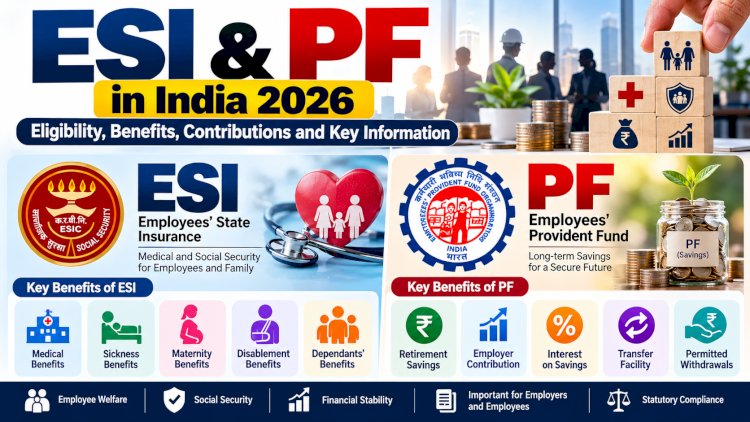
Business News: Employees’ State Insurance (ESI) and Employees’ Provident Fund (EPF) are important social security schemes for eligible employees in India. These schemes help workers access medical and social security benefits, build retirement savings and receive financial support under specified circumstances.
For employers, understanding ESI and PF requirements is essential for payroll management, employee welfare and statutory compliance. Businesses should determine which provisions apply to their establishment based on the relevant laws, employee strength, wages and other eligibility conditions.
What Is ESI?
The Employees’ State Insurance (ESI) scheme is administered by the Employees’ State Insurance Corporation (ESIC) under the Employees’ State Insurance Act, 1948.
It provides medical care and certain cash benefits to insured employees and eligible family members, subject to the scheme's rules.
Benefits of ESI
Eligible insured employees may receive:
-
Medical benefits: Medical care for insured employees and eligible family members under the scheme.
-
Sickness benefits: Cash benefits during qualifying periods of certified sickness, subject to applicable conditions.
-
Maternity benefits: Benefits for eligible insured women in accordance with scheme rules.
-
Disablement benefits: Benefits for qualifying employment-related injuries or disabilities.
-
Dependants’ benefits: Financial support for eligible dependants in specified cases of employment-related death.
-
Other prescribed benefits: Additional benefits where eligibility conditions are met.
The exact benefit depends on the insured person's circumstances, contribution record and applicable ESI provisions.
What Is PF or EPF?
The Employees’ Provident Fund (EPF) is a retirement savings scheme administered by the Employees’ Provident Fund Organisation (EPFO).
Eligible employees and their employers contribute to the provident fund in accordance with applicable rules. The accumulated balance helps employees build long-term savings for retirement and may be withdrawn or transferred in permitted circumstances.
Benefits of PF
-
Retirement savings: Builds a fund over an employee's working life.
-
Employer contribution: Eligible employees receive the employer contribution prescribed under the applicable rules.
-
Interest: The EPF balance earns interest at the rate declared for the relevant financial year, subject to scheme rules.
-
Transfer facility: Eligible members can transfer their PF balance when changing jobs.
-
Permitted withdrawals: Withdrawals may be available for specified purposes and under prescribed conditions.
-
Related social security benefits: Eligible members may also receive benefits under linked schemes, such as Employees’ Pension Scheme (EPS) and Employees’ Deposit Linked Insurance (EDLI), where applicable.
ESI and PF: Key Differences
| Particulars | ESI | EPF / PF |
|---|---|---|
| Main purpose | Medical and social security benefits | Retirement savings and related benefits |
| Administered by | ESIC | EPFO |
| Main benefit | Medical care and eligible cash benefits | Provident fund accumulation and permitted withdrawals |
| Contribution basis | Applicable ESI wage rules | Applicable EPF wage and contribution rules |
| Employee coverage | Subject to ESI coverage and wage conditions | Subject to EPF coverage and membership rules |
| Employer responsibility | Registration and contributions where applicable | Registration, contributions and member-related compliance where applicable |
ESI Eligibility and Wage Limit
ESI generally applies to covered establishments that meet the applicable coverage requirements. The commonly applicable wage ceiling for employee coverage is ₹21,000 per month, with a higher ceiling of ₹25,000 for eligible persons with disabilities, subject to the applicable rules.
The usual contribution rates are:
-
Employee contribution: 0.75% of applicable wages.
-
Employer contribution: 3.25% of applicable wages.
Employees whose average daily wages fall within the prescribed exemption threshold may be exempt from the employee contribution while remaining covered, subject to the rules.
Employers should verify the current coverage requirements, wage calculation and contribution rules with ESIC before calculating payroll deductions.
PF Eligibility and Contribution Rates
EPF coverage depends on the establishment's coverage status, employee membership and applicable wage and statutory rules.
For many covered establishments, the standard contribution rate is generally 12% of applicable PF wages from the employee and 12% from the employer, although different rates or special rules may apply in certain circumstances.
The employer's contribution is allocated according to applicable provisions, including the Employees’ Pension Scheme where the employee is eligible. The employer's total contribution should not automatically be treated as an amount credited entirely to the EPF account.
The commonly applicable statutory wage ceiling for mandatory EPF membership is ₹15,000 per month for specified purposes. Membership rules, existing membership status and voluntary contributions can affect an individual employee's position.
Employers should check the latest EPFO rules before determining coverage and contribution amounts.
How Employers Can Register for ESI and PF
Employers can generally follow these steps, subject to the applicable registration process:
ESI Registration
-
Visit the official ESIC website: https://www.esic.gov.in/
-
Open the employer registration or relevant services section.
-
Provide the establishment and employer details requested.
-
Enter the required employee and business information.
-
Submit the application and retain the registration details.
-
Complete employee registration and contribution compliance as required.
EPF Registration
-
Visit the official EPFO website: https://www.epfindia.gov.in/
-
Open the employer services section.
-
Follow the applicable establishment registration process.
-
Provide the required establishment, ownership and authorised-signatory details.
-
Complete the registration and employee-related formalities.
-
Maintain monthly contribution and return compliance as prescribed.
The exact registration workflow may change. Employers should follow the current instructions on the official portals.
Documents and Information Employers May Need
Depending on the registration and establishment type, employers may be asked for:
-
PAN and identity details of the establishment or employer
-
Business registration documents, where applicable
-
Address proof for the establishment
-
Bank account details and supporting proof
-
Details of directors, partners, proprietors or authorised signatories, as applicable
-
Employee information and wage records
-
Attendance, payroll and employment records
-
Other documents requested by the relevant authority
The final checklist should be confirmed on the official ESIC and EPFO portals.
Responsibilities of Employers
Businesses covered by ESI and EPF provisions should maintain accurate employment and payroll records, determine employee eligibility correctly and deposit contributions within the applicable deadlines.
Employer responsibilities may include:
-
Registering the establishment where required.
-
Enrolling eligible employees.
-
Calculating employee and employer contributions correctly.
-
Depositing contributions on time.
-
Maintaining payroll, attendance and wage records.
-
Completing required filings and updating employee details.
-
Responding to statutory notices and maintaining compliance documentation.
Failure to comply may result in interest, damages, penalties or other legal consequences under the applicable provisions.
Why ESI and PF Matter for Small Businesses
ESI and PF are relevant to many businesses, including shops, offices, factories, service providers and other covered establishments.
For employees, these schemes can provide medical protection, retirement savings and other eligible social security benefits. For employers, proper compliance helps improve payroll accuracy, employee confidence and statutory record-keeping.
Small businesses should review their employee count, wage structure, establishment coverage and registration status with a qualified compliance professional when necessary.
Conclusion
ESI and PF serve different but complementary purposes within India's social security system. ESI focuses on medical care and specified cash benefits, while EPF helps eligible employees accumulate retirement savings and access related benefits.
Employers should verify current eligibility rules, contribution rates, wage ceilings and registration requirements through the official ESIC and EPFO websites. Employees should also review their contribution records and understand the benefits available under their membership.
Stay connected with Luxury News for business updates, labour law information, government schemes and practical guidance for employers and employees.