Nifty Bloodbath After Shocking Reversal: Is a Bigger Crash Coming?
Nifty faces sharp selling after a sudden market reversal, raising concerns about a deeper correction. Here are the key factors investors should watch next.
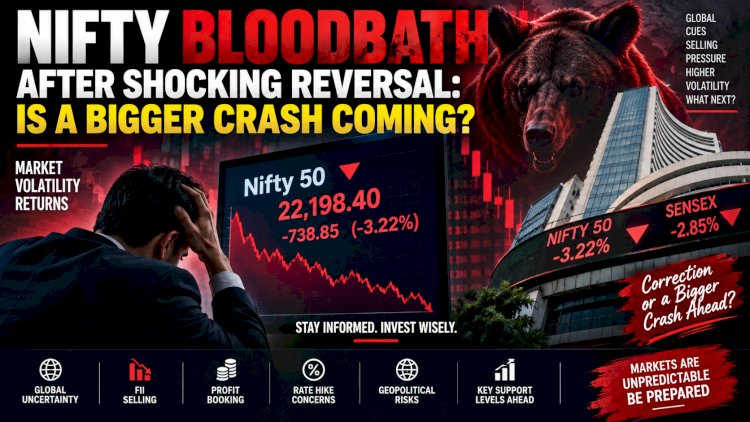
Mumbai: The Indian stock market witnessed a sharp reversal, with the Nifty 50 coming under heavy selling pressure after an earlier period of strength. The sudden change in market sentiment has raised concerns among investors about whether the decline could develop into a deeper correction.
The sharp movement has once again highlighted the fragile nature of market sentiment, particularly when global cues, institutional flows and technical factors combine to trigger aggressive selling.
Nifty Faces Heavy Selling Pressure
The reversal caught many market participants off guard as stocks that had earlier supported the market came under pressure.
Selling across key sectors can amplify declines in the benchmark index, particularly when traders begin reducing leveraged positions or moving towards safer assets.
The intensity of the fall has made the near-term direction of the Nifty a major focus for traders and investors.
Why Did the Market Reverse Suddenly?
Several factors can contribute to a sudden market reversal. These can include:
- Weak global market signals
- Profit booking after a strong rally
- Foreign institutional selling
- Concerns over valuations
- Rising volatility
- Changes in interest-rate expectations
- Geopolitical uncertainty
- Weakness in major sectors
Markets can move quickly when investors simultaneously react to new information and adjust their positions.
Is a Bigger Crash Coming?
The sharp fall does not automatically mean that a major market crash is on the way.
A correction and a crash are very different events. A correction can occur when investors take profits or reassess valuations, while a crash generally involves an extreme and sustained decline accompanied by widespread panic and liquidity stress.
For now, investors are likely to watch whether the Nifty can stabilize around important technical support levels.
A sustained break below major support zones, accompanied by increasing selling volumes, could signal further weakness. On the other hand, a strong recovery could indicate that the latest decline was primarily a profit-booking phase.
Technical Levels in Focus
Traders are expected to closely monitor recent support and resistance levels on the Nifty.
Important indicators include:
- Previous swing lows
- Moving averages
- Trading volumes
- Market breadth
- Futures and options positioning
- Volatility levels
If the index begins forming lower highs and lower lows, bearish sentiment could strengthen. Conversely, reclaiming important resistance levels could restore confidence among buyers.
What Investors Should Watch
Investors should avoid making decisions purely on the basis of a single sharp market session.
The broader market trend, corporate earnings, economic data, interest rates and global developments can all influence the direction of Indian equities.
Investors should also remember that volatility can create opportunities as well as risks. A disciplined approach, appropriate position sizing and diversification can become particularly important during periods of uncertainty.
Foreign and Domestic Institutional Flows
Institutional activity is another key factor for the market.
Foreign portfolio investor buying or selling can have a significant short-term impact on benchmark indices. At the same time, domestic institutional investors can provide support during periods of foreign selling.
Tracking institutional flows alongside market breadth can provide investors with a better understanding of whether selling pressure is broad-based or concentrated in selected stocks.
Sector Performance Could Determine the Next Move
The performance of heavyweight sectors such as banking, financial services, information technology, energy and automobiles can influence the overall direction of the Nifty.
If large-cap stocks continue to decline, the index may struggle to recover quickly. However, selective buying in major sectors could help the market stabilize.
Investors Should Stay Alert
The latest Nifty reversal is a reminder that stock markets can change direction rapidly.
Rather than attempting to predict a crash from one session, investors may benefit from watching price trends, support levels, volumes, institutional flows and fundamental developments.
The coming trading sessions could provide a clearer indication of whether the market is entering a deeper correction or simply experiencing a temporary bout of profit booking and volatility.