NSDL Launches Demat 2.0 to Power India’s Next-Generation Securities Market
NSDL launches Demat 2.0, a distributed-ledger platform supporting tokenised securities and near real-time settlement through wholesale CBDC integration.
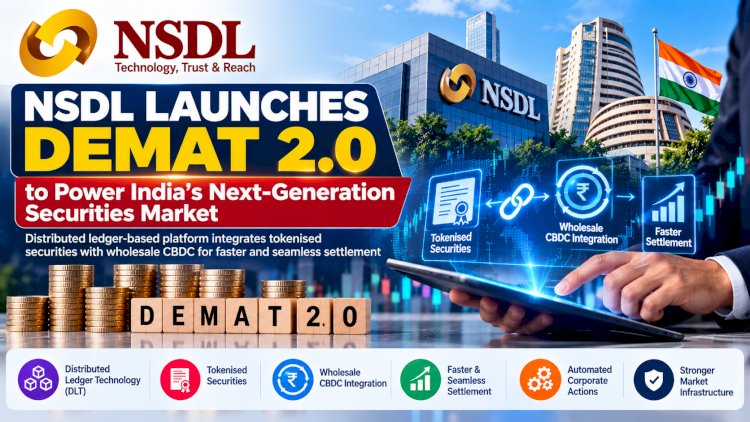
Mumbai, September 10, 2026: National Securities Depository Limited (NSDL) has launched Demat 2.0, a next-generation platform designed to support tokenised securities and enable near real-time settlement through integration with the Reserve Bank of India’s wholesale Central Bank Digital Currency (CBDC) infrastructure.
The initiative is part of a market-wide pilot for tokenised corporate bonds unveiled at the Global Fintech Fest 2026.
What Is Demat 2.0?
Demat 2.0 is built using distributed ledger technology (DLT). According to NSDL, the platform enables the simultaneous exchange of securities and funds through a delivery-versus-payment mechanism.
The system is designed to reduce operational complexity, reconciliation requirements and settlement risk. It can also support automation of corporate actions, including interest payments and redemptions through smart contracts, subject to applicable regulations.
Integration With Wholesale CBDC
One of the key features of Demat 2.0 is its integration with the RBI's wholesale CBDC infrastructure.
The platform is intended to bring securities and payments together on a digital infrastructure, supporting faster settlement and more streamlined processing.
India's Growing Demat Ecosystem
NSDL said that India had approximately 25 crore demat accounts as of August 2026, while the estimated number of unique investors stood at around 13 crore. The figures highlight the scale of India's expanding investment ecosystem.
Demat 2.0 is designed to extend the existing demat framework while retaining the existing legal structure, KYC framework, investor rights and regulatory safeguards.
Tokenised Securities and Corporate Bonds
NSDL's distributed-ledger platform has already been used for regulated tokenised securities transactions.
The press release states that tokenised bond issuances by REC Limited, Larsen & Toubro Limited and IIFL aggregated ₹1,025 crore, including a ₹500 crore tokenised non-convertible debenture issuance by Larsen & Toubro.
From Physical Certificates to Digital Infrastructure
India's securities settlement system has undergone significant technological changes over the past three decades.
NSDL pioneered electronic dematerialisation in 1996. According to the organisation, settlement cycles subsequently evolved from T+5 and T+3 to T+1, with optional T+0 settlement available in selected market segments.
Demat 2.0 represents another stage in this development, with an emphasis on distributed-ledger technology and integration between securities and digital payments.
What It Could Mean for the Securities Market
According to NSDL, the platform aims to provide:
- Faster settlement
- Streamlined asset servicing
- Reduced reconciliation requirements
- Greater operational efficiency
- Support for tokenised securities
- Integration of securities and payments
The platform is intended to operate within existing investor-protection and regulatory frameworks.
NSDL's Vision for the Next Generation of Markets
NSDL Managing Director and CEO Vijay Chandok described Demat 2.0 as the next phase of India's dematerialisation journey, bringing securities and payments together through next-generation digital infrastructure.
The development highlights the continuing use of digital technologies in India's capital-market infrastructure and the growing role of tokenised assets and distributed-ledger systems.
Key Details
Organisation: National Securities Depository Limited (NSDL)
Platform: Demat 2.0
Launch: September 10, 2026
Location: Mumbai
Technology: Distributed Ledger Technology (DLT)
Key Focus: Tokenised securities and faster settlement
Payment Integration: RBI wholesale CBDC infrastructure
Market Application: Tokenised corporate bonds